 tr
tr de
de
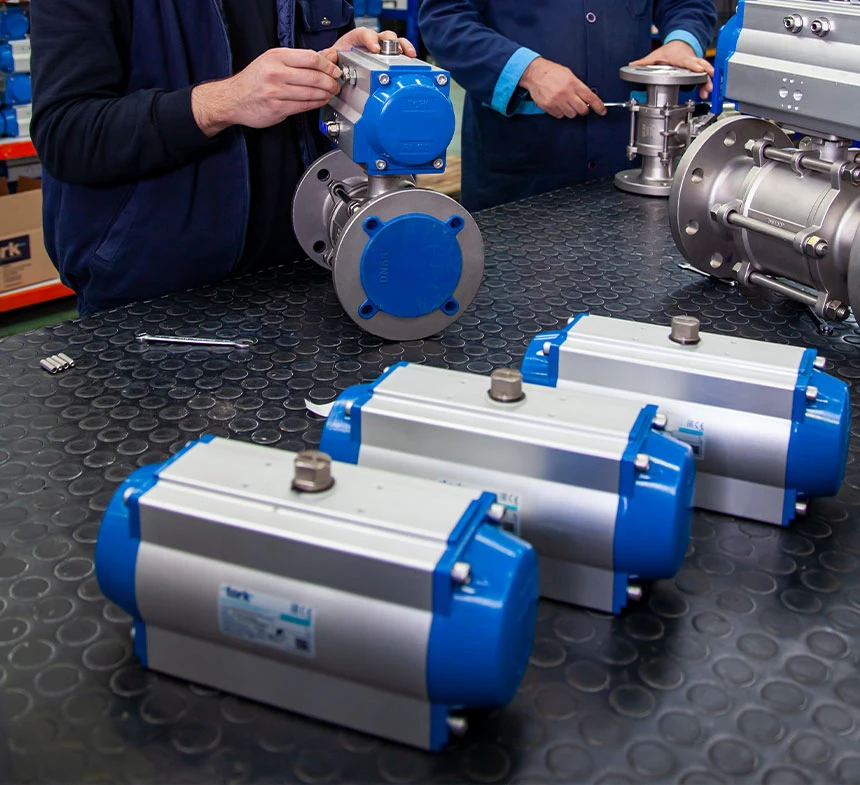
Comparison of Scotch Yoke and Rack & Pinion Actuators
Pneumatic actuators are widely used in process automation for the on-off control of quarter-turn valves such as butterfly valves and ball valves. These actuators usually operate with a 90-degree rotation, although 120° and 180° rotation versions are also available. Selecting the wrong actuator mechanism can directly and negatively impact system performance.
General Advantages of Pneumatic Actuators
Compared to electric or hydraulic actuators, pneumatic actuators offer two main advantages:
- Fast open/close operation
- Economical design
Small pneumatic actuators can complete a 90-degree movement in about 1 second, while larger actuators can achieve this in 5–6 seconds. In contrast, electric or hydraulic actuators often require 10–20 seconds or more. Therefore, pneumatic actuators are preferred for applications that require rapid response.
Pneumatic Actuator Mechanisms
Pneumatic actuators are generally produced with two primary mechanisms:
- Rack & Pinion
- Scotch Yoke
Both mechanisms convert the linear motion of pistons into rotational motion of the shaft connected to the valve. However, the methods of conversion and resulting performance characteristics differ.
How the Rack & Pinion Mechanism Works
In Rack & Pinion actuators, the piston movement is transferred to the shaft via a gear system. When the pistons move under air pressure, the shaft rotates through the gear mechanism, operating the valve. Reversing the air pressure reverses the movement.
Key features of Rack & Pinion actuators:
- More compact body design
- Lower cost
- Constant torque between 0–90 degrees (especially in double-acting models)
These features make Rack & Pinion actuators suitable for general-purpose and economical applications.
How the Scotch Yoke Mechanism Works
In Scotch Yoke actuators, there is no gear system. The linear movement of the pistons is directly converted into rotational motion through a mechanical setup called the Scotch Yoke. This design provides a mechanically robust structure.
Advantages of Scotch Yoke actuators:
- Stronger and more durable design
- High initial torque capacity
However, there are some drawbacks:
- Pistons travel a longer distance to complete 90° rotation
- Open/close time may be 1–2 seconds longer than Rack & Pinion
- Larger and longer body design may increase cost
Torque Characteristics Comparison
- Rack & Pinion actuators maintain a nearly constant torque throughout the 0–90° rotation.
- Scotch Yoke actuators have a variable torque profile:
- High torque at 0°
- Minimum torque around 45°
- Torque increases again towards 90°
This variable torque is often not a disadvantage. On the contrary, in butterfly valves, higher torque is naturally required during initial opening or closing, which the Scotch Yoke mechanism provides.
Size and Cost Considerations
Although Scotch Yoke actuators have a higher unit cost, their high initial torque often allows the use of a smaller actuator size. This can balance total system cost, making Scotch Yoke actuators an economical option in some cases.
Rack & Pinion actuators, being more compact and affordable, are advantageous for standard applications. However, they may not provide the same strength as Scotch Yoke actuators for high-torque or heavy-duty processes.
Conclusion
Rack & Pinion and Scotch Yoke actuators provide solutions for different process requirements. Choose Rack & Pinion for compact design, constant torque, and low cost. Choose Scotch Yoke for high durability, strong initial torque, and demanding applications. Selecting the wrong actuator can lead to performance loss and unnecessary costs, so application conditions must be carefully evaluated.
