
 tr
tr de
de
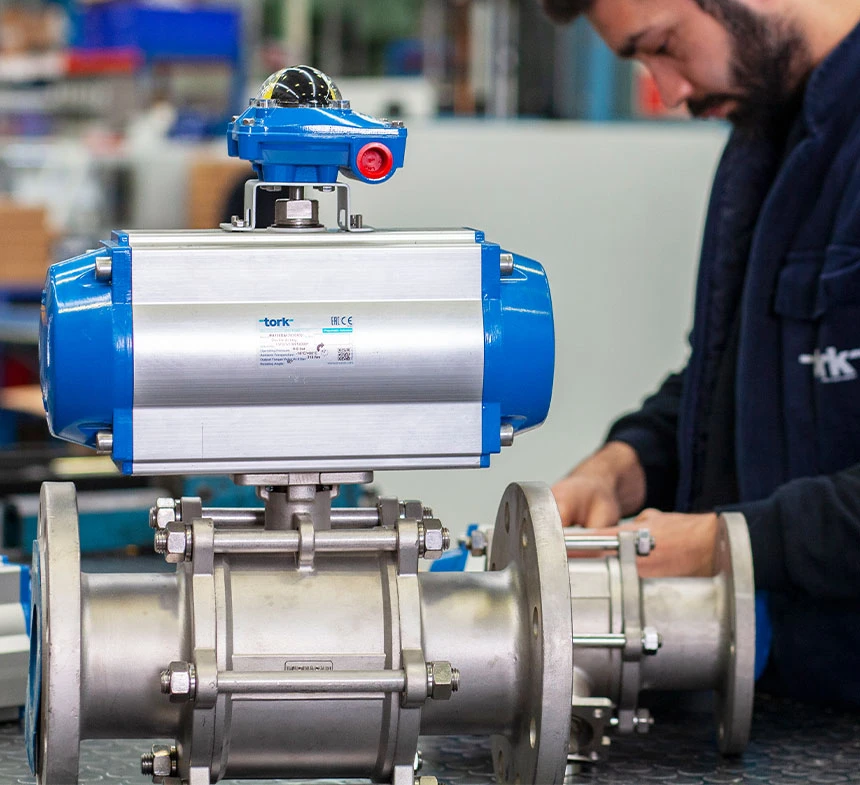
The Role of Positioners and Directional Valves in Process Automation
In process automation systems, valve control is critical for managing flow safely and efficiently. In industry, valves are primarily controlled using two methods: on-off control and proportional control. Selecting the correct control method according to application requirements directly affects system performance.
On-Off Valve Control
If a valve only needs to operate fully open or fully closed in a process line, the on-off control method is used. In such applications, flow is not adjusted precisely; the goal is simply to start or stop the flow.
On-off actuators are typically used for this type of control. Their simple and reliable design makes them widely preferred in many industrial applications.
Proportional Valve Control
In some processes, on-off operation alone is insufficient. The flow rate must be controlled gradually and accurately. In this case, proportional actuators are used.
Proportional control allows the valve to be positioned at a specific angle, maintaining the desired flow rate. This method is particularly useful in applications requiring precise process control.
Directional Valves in Pneumatic Actuators
For pneumatic actuators, if the goal is only on-off control, this can be achieved via directional valves. Directional valves control the airflow to the actuator, enabling the valve to open or close.
Directional valves:
- Can be mounted directly on the actuator
- Can also be installed remotely in a panel
A signal sent to the coil activates the directional valve and performs the on-off motion of the valve.
Proportional Control with Pneumatic Positioners
When proportional control is needed for pneumatic actuators, pneumatic positioners are used. Positioners are usually mounted on the actuator and continuously monitor its movement.
Pneumatic positioners:
- Track the actuator’s rotation angle
- Balance air pressure on both sides of the piston
- Adjust actuator position according to a 4–20 mA control signal
This allows the actuator to maintain a desired angle between 0–90 degrees, providing precise control of the fluid flow through the valve.
Position Control in Electric Actuators
In electric actuators, proportional control is achieved differently. External positioners are not required. Control is performed via integrated electronic boards within the actuator.
Electric actuators can be controlled using analog signals such as:
- 4–20 mA
- 0–5 V
- 0–10 V
The electronic board maintains the actuator at the desired angle based on the incoming signal, allowing precise flow control through the valve.
Conclusion
Valve control in process automation should be determined according to application needs, control accuracy, and system design. On-off control provides simple and fast solutions, while proportional control ensures precise flow management. Directional valves and positioners are essential in pneumatic systems, whereas integrated electronic control boards are key in electric systems. Choosing the right control method enhances both energy efficiency and process safety.
