
 tr
tr de
de
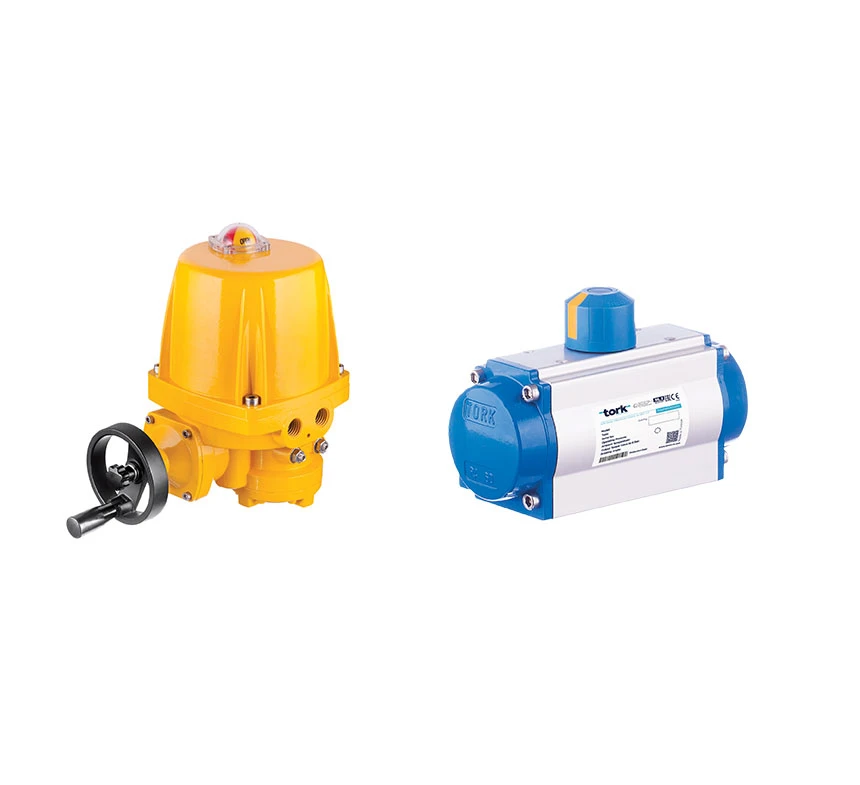
Differences, Advantages, and Applications
Actuators are fundamental devices in process flow automation that control the opening, closing, and positioning of valves. Actuators are commonly used for quarter-turn valves such as ball valves and butterfly valves. They are mainly classified into two groups: electric actuators and pneumatic actuators. Understanding the differences and applications of these two systems is critical for process efficiency.
Basic Operating Principle of Electric and Pneumatic Actuators
Electric actuators operate valves using electrical energy to perform opening and closing movements. Pneumatic actuators achieve the same using compressed air.
Both actuator types typically operate with a 90-degree rotation. In special applications, multi-position actuators capable of controlling valves with 120° or 180° rotation are also used.
Advantages of Pneumatic Actuators
Pneumatic actuators are among the most widely used actuator types in industry, mainly due to their cost-effectiveness and fast operation times.
Key advantages include:
- Relatively lower cost
- Fast open/close operation
- Ideal for processes requiring frequent actuation
For small-diameter valves (e.g., 1”–2”), the open/close time is around 1–2 seconds. For larger valves, such as DN650 butterfly valves, pneumatic actuators may require 5–6 seconds for full operation.
Control and Feedback in Pneumatic Actuators
Pneumatic actuators are controlled via directional valves. A directional valve directs compressed air to the actuator, and an electrical signal to the coil controls the opening and closing motion.
If feedback is required, a switch box can be used:
- It physically indicates whether the actuator is open or closed
- Sends a switching signal to the automation system to report valve position
Additionally, in case of power or air failure, a manual open/close unit installed between the valve and actuator allows the system to be operated manually.
Advantages of Electric Actuators
Electric actuators offer advantages in compact design and simplicity. All control components are integrated into a single housing.
Electric actuators:
- Include a position indicator on the device
- Provide feedback signals via internal switches
- Do not require an external switch box or directional valve
Manual override for emergency operation is standard, allowing the valve to be opened or closed manually if needed.
Disadvantages of Electric Actuators
The main disadvantage of electric actuators is slower open/close times compared to pneumatic actuators:
- Small valves: 90° rotation in ~13–15 seconds
- Large valves: up to 25–30 seconds
Thus, electric actuators may not be ideal for processes requiring very frequent or rapid operation.
Which Actuator to Choose for Which Application?
In industry:
- Pneumatic actuators are preferred for high-speed, frequent open/close operations
- Electric actuators are suitable for systems with limited daily operation
Electric actuators provide a compact and practical solution where compressed air infrastructure is limited.
Conclusion
Electric and pneumatic actuators offer solutions for different process needs. Factors such as speed, actuation frequency, infrastructure availability, and cost must be considered when selecting the right actuator. A proper choice enhances both process safety and long-term system efficiency.
