
 tr
tr de
de
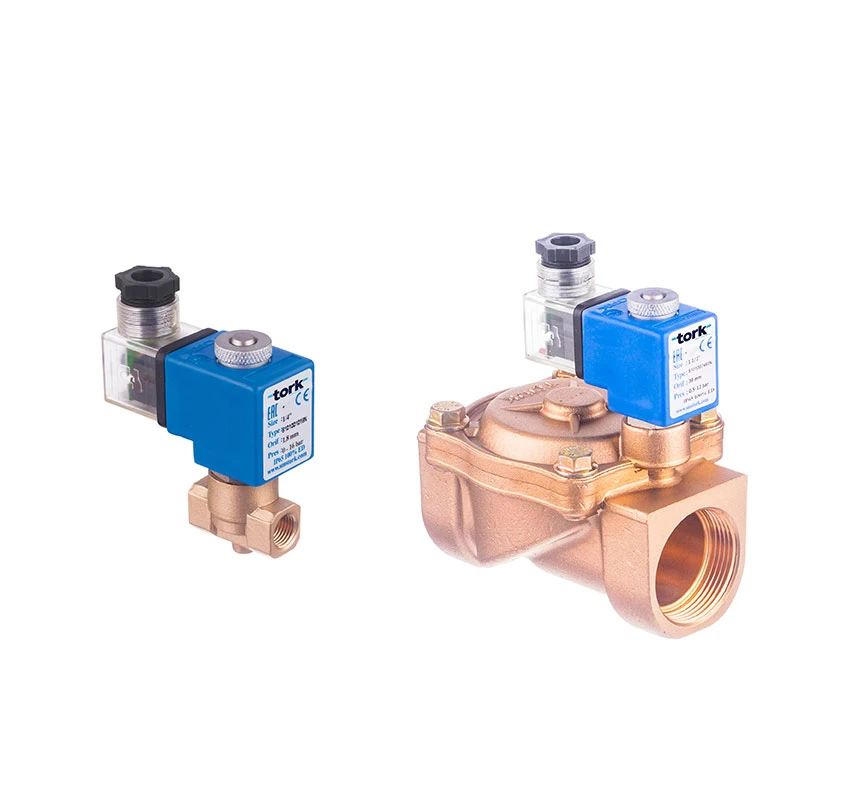
Solenoid valves are among the most widely used control devices in process flow automation. Due to their compact design, cost-effectiveness, and wide product range, they are preferred in many industrial applications. Fundamentally, solenoid valves can be divided into two main types based on their operating principle: direct-acting solenoid valves and pilot-operated solenoid valves.
What is a Direct-Acting Solenoid Valve?
Direct-acting solenoid valves are typically used for small orifice sizes. Here, "size" refers to the diameter of the orifice inside the solenoid valve. When the orifice is small, the magnetic force generated by the solenoid coil directly moves the plunger to open or close the valve.
These valves are generally used for:
- 1/8” and 1/4” connection sizes
- Orifice diameters up to 10 mm
In direct-acting solenoid valves, the plunger directly controls the sealing element. This allows the valve to open and close solely with the coil’s energy, without requiring any external pressure differential.
What is a Pilot-Operated Solenoid Valve?
As the orifice size increases, the plunger alone cannot operate the valve. In this case, pilot-operated solenoid valves are used. These valves rely on line pressure to assist the opening and closing operation rather than solely on magnetic force.
The main component of a pilot-operated solenoid valve is the diaphragm, which has a small pilot hole. Fluid from the inlet line fills the upper part of the diaphragm through this hole.
How Pilot-Operated Solenoid Valves Work
Even if the pressure on both sides of the diaphragm is the same, the larger surface area on the top creates a greater force. This force:
- Presses the diaphragm downward
- Keeps the valve closed
- Maintains sealing integrity
When the solenoid coil is energized, the pilot line activates. Pressure accumulated above the diaphragm is released to the outlet line. With the upper pressure reduced, the inlet line pressure pushes the diaphragm upward, opening the valve.
Differential Pressure Requirement in Pilot-Operated Solenoid Valves
For proper operation, pilot-operated solenoid valves require a minimum pressure differential between the inlet and outlet. This required differential varies depending on the valve size, design, and construction.
Typically, a pressure differential of:
- 0.35 – 0.5 bar
is needed. Without sufficient differential, the valve may not fully open or close, or may operate unstably.
Direct-Acting vs. Pilot-Operated
- Direct-acting solenoid valves are preferred for low-flow, small-orifice, low-pressure applications.
- Pilot-operated solenoid valves are more efficient and reliable for high-flow and large-orifice applications.
Selecting the appropriate solenoid valve type according to application requirements directly impacts system performance and long-term operational safety.
